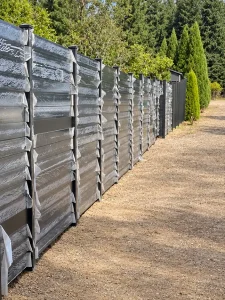
Aluminum Privacy Fence Slat Spacing Guide: Full Privacy vs Semi-Privacy
Aluminum fence slat spacing changes what you can see through the fence, how open the boundary feels and how its lines relate to the building. Choosing a gap is therefore a design decision as well as an order dimension.
This guide helps contractors, distributors and project buyers specify the difference between full privacy and semi-privacy, compare spacing examples and prepare a clear custom fence inquiry for Wonderful Metal.
Full Privacy vs Semi-Privacy: What Changes?
A full privacy design uses a closed infill arrangement to screen direct views through the panel face. A semi-privacy slat fence has deliberate openings between the profiles. Even narrow openings can permit views from certain positions.
Evaluate the whole boundary: the space below the panel, clearances beside posts and gaps around a gate can remain visible even when the infill itself is closed.
For product context, see our black aluminum privacy fence panel. Confirm the final profile and joint detail on the approval drawing.

| Design aspect | Full privacy | Semi-privacy |
|---|---|---|
| Panel face | Closed arrangement without deliberate sightline openings | Repeated openings between slats |
| Visual screening | Stronger screening through the face | Views remain possible through gaps |
| Air path | No deliberate through-gaps in the infill | Openings provide an air path |
| Appearance | More continuous surface | More pronounced light and shadow between profiles |
| Typical design objective | Private patios and screened outdoor areas | Boundaries balancing screening and openness |
Privacy is not a single percentage derived from a front-facing photograph. Check the fence from the positions that matter: a neighboring window, an elevated path, a patio chair or a person standing close to the boundary.
Specify Clear Gap, Slat Width and Pitch Separately
- Clear gap: the finished open space between adjacent slats.
- Visible slat width: the face dimension seen in the panel elevation.
- Pitch: the repeated distance between corresponding points on adjacent slats.
- Profile depth: the front-to-back dimension, which can affect angled sightlines.
For equally spaced flat profiles, pitch equals visible slat width plus clear gap. Confirm whether the dimensions refer to finished, coated parts and record the agreed manufacturing tolerance.
Illustrative Gap Comparison
| Visible slat face | Clear gap | Pitch | Idealized open fraction |
|---|---|---|---|
| 100 mm | 5 mm | 105 mm | 4.8% |
| 100 mm | 10 mm | 110 mm | 9.1% |
| 100 mm | 20 mm | 120 mm | 16.7% |
These are calculation examples, not standard Wonderful Metal configurations. The idealized open fraction is gap ÷ pitch for a repeating flat layout. It excludes frames and edge clearances and is not a privacy rating, ventilation rate or wind-load reduction factor.
With the same slat width, a smaller gap creates a denser elevation. A larger gap makes the pattern more open. Neither spacing alone establishes whether the fence is suitable for a particular site or use.
Calculate the Slat Layout Before Ordering
For horizontal slats with no overlap, calculate the occupied infill height as:
Infill height = number of slats × visible face width + (number of slats − 1) × internal gap.
For example, 15 slats with a 100 mm visible face and fourteen 10 mm gaps occupy 1,640 mm. Add the specified frame and edge allowances separately to determine the complete panel height.
For vertical slats, apply the same calculation across the infill width. Interlocking or overlapping profiles require the effective installed cover dimension rather than simply the physical profile width.
Keep the Last Slat and Edge Gaps Intentional
Check how the pattern finishes at the panel edges. If the available infill dimension does not match a whole number of slats and gaps, discuss an adjusted gap, a different profile size or another agreed termination detail.
Do not leave the final distribution to guesswork during installation. Show slat count, internal gaps and edge clearances on the approval drawing.
How Spacing Affects Airflow, Light & Appearance
Airflow
Spaced slats provide an opening through the infill. Actual airflow depends on wind direction, profile depth, surrounding buildings and the complete layout.
For equipment screening, follow the equipment manufacturer's required clearances and ventilation criteria. A gap percentage alone does not establish adequate ventilation.
Light & Visual Rhythm
Closely repeated slats create fine lines; wider gaps produce stronger stripes of background and daylight. Compare the design beside windows, façade joints and other repeated features.
Review samples in relevant lighting. Contrast between a dark fence and a bright background can make small gaps more noticeable.
Horizontal, Vertical or Louvre?
Horizontal slats create a repeated pattern across the fence height. Vertical slats repeat across its width. Louvre blades introduce an angle, so their screening effect depends on the direction of view.
Udforsk horizontal slat fencing og louvre fence options. Request a section drawing when comparing directional screening.
Review Supports When the Privacy Level Changes
Changing from open slats to closed infill changes the assembly's exposure to wind. Have the project support and connection design reviewed for the final configuration. Do not assume that adding gaps allows the same proportional reduction in post or foundation requirements.
Dimensions to Confirm in a Slat Fence Inquiry
| Dimension or detail | What to provide |
|---|---|
| Complete panel | Overall height and width, with units |
| Infill opening | Clear area inside the frame or supporting channels |
| Slat profile | Visible width, depth and required wall specification |
| Slat pattern | Direction, quantity, clear internal gap and edge gaps |
| Post arrangement | Clear openings or center distances, clearly identified |
| Site levels | Ground clearance, slope and height transitions |
| Gates | Clear passage, leaf dimensions and intended pattern alignment |
| Finish & quantity | Color, texture, panel schedule and sample requirements |
Include the destination and the purpose of the fence. Contractors and importers should identify special closing panels, corners and gate sections separately from repeated panels.
For matching entrances, review aluminum gate options with the fence elevation. Gate hardware and operating clearances may prevent the slat pattern from continuing without a break.
Custom Supply from China
Wonderful Metal accepts custom inquiries covering dimensions, slat arrangement, finishes, posts and gates. A clear drawing helps coordinate these items in one purchasing schedule.
For project or repeat orders, discuss approved samples, component labels and packing by drawing reference. Confirm the exact profile, tolerance, supply scope and delivery terms before production.
Request custom manufacturing details → View project references →
Aluminum Fence Slat Spacing FAQs
What is the best gap for an aluminum privacy fence?
It depends on the required screening, profile geometry and appearance. Start with a section drawing and a sample rather than a universal gap recommendation.
Does a 5 mm gap provide full privacy?
A deliberate 5 mm opening remains a possible sightline. Review the profile and viewing angles; narrow spacing alone does not make a closed privacy panel.
Does 10% open area mean 10% airflow?
No. Geometric open area does not translate directly into airflow. Air movement depends on pressure, direction, geometry and surrounding obstructions.
Can I change spacing without changing the panel size?
Possibly, but the slat count or edge arrangement may also need to change. Recalculate the pattern and approve the revised drawing.
Can the same gap be used in a matching gate?
Ask for a coordinated elevation. The gate frame, hardware and clearances must also be considered.
Is slat spacing alone enough to specify a pool barrier?
No. The complete design and installation require a separate review against the applicable project requirements, including gates, clearances and climbability.
Choose the Right Slat Layout with Wonderful Metal
Send your panel dimensions, preferred profile, clear gap, quantity and destination. Add a reference photo and explain where screening or airflow matters most.