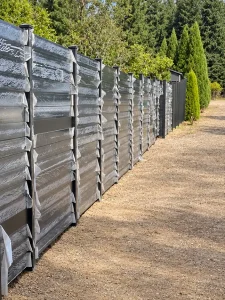
Choosing aluminum fence posts involves more than matching their color to the panels. Posts connect the fence to its supporting structure, establish the installation layout and support entrances where gates are required.
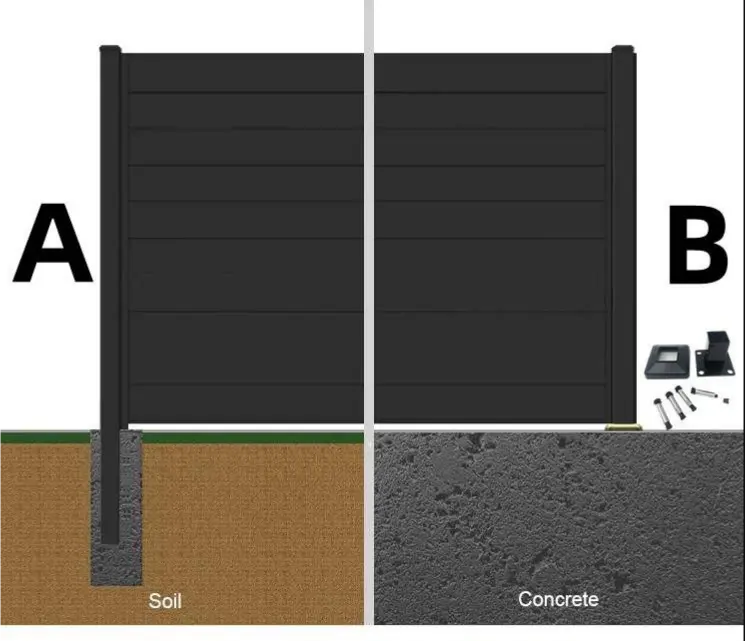
The two main mounting arrangements are base plate posts, fixed to a suitable structural surface, and in-ground posts, embedded within a designed foundation.
The appropriate choice depends on the fence, ground conditions, existing structures and installation requirements.
Wonderful Metal supplies aluminum post systems with base plate, embedded and reinforced configurations. Explore our Aluminum Post collection to review current products and customization options.
Base Plate vs In-Ground Aluminum Fence Posts
| Selection factor | Base plate posts | In-ground posts |
|---|---|---|
| Mounting arrangement | Attached to a suitable structure using specified anchors | Extend below ground into a designed foundation |
| Site information needed | Substrate material, dimensions, condition and edge distances | Ground conditions, finished levels and foundation requirements |
| Visible appearance | Base plate and fixings may remain visible | No surface-mounted base plate |
| Installation work | Substrate verification, drilling and anchor installation | Excavation, foundation construction and post positioning |
| Main components to coordinate | Post, plate, connection and anchor group | Post, embedment and foundation |
| Replacement | Depends on access and connection details | May require foundation work |
| Suitability | Determined by the complete design | Determined by the complete design |
Neither arrangement is automatically stronger or less expensive. Compare the complete supporting system.
What Are Base Plate Aluminum Fence Posts?
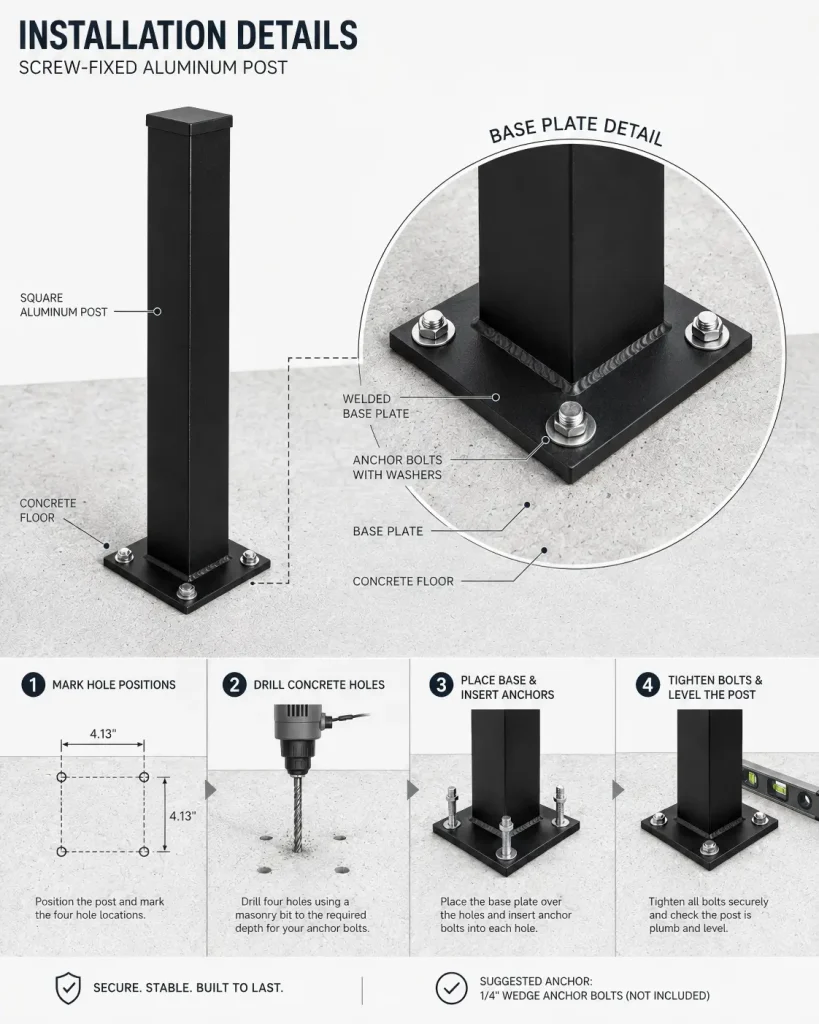
A base plate post connects an upright aluminum profile to a plate at its lower end. The plate is secured to a suitable supporting structure.
Buyers may also describe these as surface mount aluminum fence posts.
They can be evaluated for prepared concrete foundations or other structures designed to support the fence. An existing paved surface alone does not establish that base plate mounting is suitable.
Check the Supporting Surface
Before selecting anchors, establish:
- What material lies beneath the visible finish.
- The structural thickness and dimensions.
- The location of edges and openings.
- The condition of the supporting material.
- Relevant reinforcement or concealed services.
- The loads the connection must resist.
Paving blocks, a decorative wall cap or a thin concrete topping should not automatically be treated as a structural foundation.
Review the Complete Connection
A base plate detail should show the plate dimensions, thickness, hole arrangement and connection to the post.
The anchor selection must suit the substrate and design requirements. Hole preparation, installation conditions, embedment and tightening depend on the specified anchor.
A larger plate or additional bolts do not, by themselves, establish an adequate connection.
What Are In-Ground Aluminum Fence Posts?
An in-ground or embedded post extends below the finished ground level into a designed foundation.
This arrangement requires coordination between the visible fence height, overall post length, embedment and foundation.
Post Length Is Not Fence Height
For an embedded installation:
Overall post length = exposed post length + specified embedment
The exposed length may also differ from the panel height because of bottom clearance, post caps and connection positions.
Confirm each dimension on the drawing rather than ordering a post solely by the nominal fence height.
Foundation Dimensions Are Project-Specific
Foundation depth and width depend on the supporting conditions and loads.
Relevant factors can include:
- Soil conditions.
- Groundwater and drainage.
- Frost exposure where applicable.
- Fence height and openness.
- Site wind exposure.
- Gate loads.
- Nearby slopes or structures.
A depth published for one product should not be treated as a universal installation requirement.
Line, End, Corner and Gate Posts
Post names identify their positions in the layout. Their actual profiles, holes and connections depend on the selected system.
| Post type | Position and function |
|---|---|
| Line post | Continues a fence run between adjacent panels |
| End post | Terminates a run with a connection on the required side |
| Corner post | Supports connections where the fence changes direction |
| Gate post | Supports the specified gate or its receiving hardware |
| Transition post | Accommodates changes in height, slope or panel arrangement |
Mark these positions on the site plan before preparing quantities.
For an angled corner, provide the actual change in direction. A connection designed for a right-angle corner may not suit another angle.
How to Specify Aluminum Fence Post Sizes
The outside dimensions are only one part of a post specification.
Ask for a drawing identifying:
- Profile width and depth.
- Wall thickness.
- Internal geometry.
- Alloy and temper.
- Overall length.
- Connection holes or brackets.
- Base plate or embedded arrangement.
- Reinforcement, where required.
- Surface finish.
Two posts with the same outside dimensions may have different structural properties because their wall thicknesses and internal profiles differ.
Reinforced Posts
Where reinforcement is proposed, define the complete assembly.
Identify the reinforcement material, dimensions, connection method and any required isolation or protection between materials. Confirm how panel brackets and gate hardware attach to the assembly.
Reinforcement should be selected for the actual requirement rather than added without a defined purpose.
Posts for Aluminum Privacy Fences
A closed privacy fence can place different demands on its posts from an open panel.
Post selection should consider panel height, width, infill arrangement, connections and exposure together.
Do not choose a post from appearance alone or assume that a post used for a lower open fence is suitable for a taller privacy system.
Explore our Aluminum Privacy Fence Panels USA when defining the panel configuration.
For upright designs, review Vertical Aluminum Fence Panels USA.
Aluminum Gate Posts Need Separate Review
A gate post supports a moving assembly. Its requirements may differ from those of an ordinary fence post.
Specify:
- Gate opening and leaf dimensions.
- Gate weight or approved construction.
- Hinge arrangement.
- Swing direction or sliding system.
- Stops, closers and other hardware.
- Frequency of use.
- Any automation requirements.
The hinge post and latch-side post may perform different functions.
Gate hardware should have defined fixing locations. Do not assume that a hinge can be attached anywhere on a hollow profile without reviewing the connection.
Explore our Aluminum Gate collection for entrance designs.
Post Spacing and Panel Connections
Before installing posts, confirm how panel dimensions relate to the openings.
| Measurement | Meaning |
|---|---|
| Panel width | Manufactured panel dimension |
| Clear opening | Distance between facing post surfaces |
| Post-center spacing | Distance between adjacent post centerlines |
| Connection allowance | Space or engagement required by the fittings |
These measurements are different.
Bracket-mounted panels and rails entering routed posts can require different installation modules. Confirm the intended arrangement before setting foundations or drilling anchor positions.
Our Aluminum Fence Installation Guide explains these measurements in more detail.
Fence Posts on Sloped Ground
A slope affects post lengths, connection elevations and the panel layout.
For stepped fencing, adjacent panels can meet a post at different heights. For rackable systems, the installed spacing must follow the selected product’s instructions.
Custom slope panels require their own approved elevation drawings.
Provide finished ground levels at proposed post locations and identify changes within each bay. Do not rely only on an average slope across the property.
If posts will be mounted on a retaining wall, review the wall and fence connection together. Fence posts should not be assumed capable of supporting retained soil.
Powder-Coated Posts and Finish Matching
Specify the post finish together with the panels and gates.
For black aluminum fence posts, confirm the shade and gloss. If matching an existing fence, request a sample.
Include caps, base covers and exposed brackets in the finish schedule where required.
Also ask for the care instructions and approved treatment of damaged surfaces. A cosmetic repair should not be used to conceal a damaged structural connection.
Which Mounting Method Costs Less?
Compare the installed arrangement rather than the post price.
Base Plate Cost Items
A budget may include:
- Post and base plate.
- Specified anchors.
- Substrate assessment.
- Drilling and installation.
- Leveling or bearing details.
- Any required substrate repairs.
In-Ground Cost Items
A budget may include:
- Longer posts.
- Excavation.
- Foundations.
- Positioning and temporary support.
- Concrete placement.
- Site restoration.
Existing conditions can change the comparison substantially. A suitable prepared foundation may simplify surface mounting, while an unsuitable slab may require additional work.
Obtain an installation scope for the actual site before deciding.
Information to Send for a Post Quotation
| RFQ item | Information needed |
|---|---|
| Fence system | Style, height, panel width and privacy level |
| Layout | Runs, corners, transitions and gate positions |
| Post quantities | Line, end, corner and gate positions |
| Mounting | Base plate or embedded proposal |
| Site conditions | Soil information or supporting structure details |
| Abmessungen | Required profile and length, where established |
| Connections | Panel brackets, holes and gate hardware |
| Fertigstellen | Color reference and gloss |
| Delivery | Quantity and destination ZIP code |
Photographs help explain the site. Drawings and dimensions are needed to confirm the manufacturing specification.
Contractors can review Aluminum Fence for Contractors USA. Distributors can explore Wholesale Aluminum Fence Panels USA.
Häufig gestellte Fragen
Can aluminum fence posts be mounted on concrete?
They can be evaluated for a suitable concrete structure. Confirm the substrate, plate and anchors before installation.
Are embedded posts stronger than base plate posts?
Neither method guarantees greater strength. Performance depends on the complete post, connection and supporting design.
How deep should an aluminum fence post be embedded?
Use the approved project requirement. There is no single depth suitable for every fence and site.
Can ordinary fence posts support a pedestrian gate?
Only where the selected post and supporting arrangement are suitable for that gate. Review hinge and latch connections separately.
Can post holes and brackets be prepared before delivery?
Provide the approved connection positions for manufacturing review. Confirm panel dimensions, elevations and hardware first.
Can base plate posts be installed on paving blocks?
Paving blocks alone should not be assumed to provide structural support. Establish the supporting structure beneath them and the approved connection.
Request Your Aluminum Fence Post Quote
Send Wonderful Metal your fence layout, panel specifications, post quantities, mounting proposal, gate details and finish requirements.
Include site photographs and drawings so the panels, posts and connections can be coordinated within a clearly defined supply scope.
Request a Custom Aluminum Post Quote
E-Mail: [email protected]