Are Aluminum Fences Good for Dogs?
Aluminum fencing can be a suitable boundary for dogs when panel spacing, height, ground clearance and gates are selected for the individual animal and site. A standard fence is not automatically suitable for a small puppy, a jumper or a dog that digs.
For contractors, distributors and residential project buyers, build a dog-friendly aluminum fence specification around the smallest animal, expected behavior and the complete installed boundary.

Start with the Dog, Not Only the Fence Style
Size and growth
Plan for the smallest dog using the space, including the puppy stage. Assess openings for escape and head or body entrapment; adult size alone is not enough.
Behavior
Identify jumping, climbing, digging, chewing and pushing behavior. A fence cannot replace supervision or an appropriate containment plan for the individual dog.
Site conditions
Check slopes, soft soil, retaining walls, raised beds and objects beside the fence. These can change the effective clearance or height of the boundary.
Dog-Friendly Fence Configurations to Discuss
The following are design approaches to discuss with Wonderful Metal, not confirmed stock pet-fence models. Feasibility, dimensions and suitability must be agreed for the order.
Closer-spaced vertical infill
A proposed vertical slat or picket arrangement with reduced clear openings. Specify actual clear gap dimensions, including tolerance and any changes at corners.
Denser lower infill
A proposed lower section with closer spacing for smaller animals. Review every opening and transition; upper openings still matter as the dog grows or climbs.
Privacy-oriented layout
A closely arranged slat layout may reduce visibility through the boundary. Review panel joints, bottom clearance and gates as carefully as the panel faces.
Define Clear Gaps on the Approved Drawings
| Location | What to check |
|---|---|
| Between slats or pickets | Actual clear opening, not simply center-to-center spacing. |
| Under panels | Maximum clearance after installation, including uneven ground. |
| Gate edges and bottom | Gaps when closed, tolerances and potential movement. |
| Corners and transitions | Openings beside posts, stepped panels and changes in height. |
| Lower infill transitions | Gaps between denser and standard sections. |
| Adjacent structures | Access around walls, sheds or other boundary interfaces. |
There is no universal gap dimension that is appropriate for every dog. Ask an appropriate animal-care professional if you are unsure about entrapment or behavioral risks. Do not test an opening by forcing an animal’s head or body through it.
Height, Climbing and Digging Need Separate Decisions
Fence height should reflect the dog’s behavior and the site, subject to applicable local rules. Keep climbable objects away from the boundary and review whether rails or nearby structures provide footholds.
A panel above soil does not provide an underground barrier. If digging is a concern, discuss a suitable site-specific ground treatment with the installer. Coordinate any proposed below-ground detail with drainage, foundations and landscaping. Standard fence panels should not be advertised as dig-proof.
Matching Gates Are Part of the Containment Plan
Select matching aluminum gates with the same attention to clear openings as the panels. Agree latch position, hinges, opening direction and operating clearances. Verify the gate closes and latches reliably under actual site conditions.
For busy entrances, discuss whether an additional managed gate arrangement would suit the site. Do not assume an animal cannot operate a latch. Inspect rubbing, looseness and gaps as the installation settles or wears.
Choose a Style That Meets the Site Brief
Vertical slats
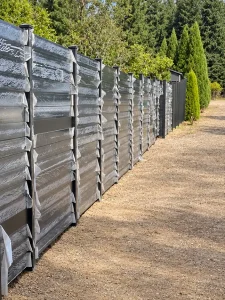
Vertical aluminum slat fencing offers a basis for discussing different clear-gap arrangements. Confirm the full panel and gate specification.
Picket boundaries
Aluminum picket fencing keeps views open. Select top details and openings with animal contact and the intended use in mind.
Horizontal privacy layouts
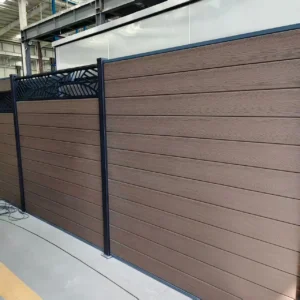
Horizontal slat fencing offers different openness levels. Review whether the geometry could support climbing for the particular dog.
Strength and Finish: Evaluate the Complete Fence
Review slat, rail and post sections, connections and mounting for the intended loads. A lightweight aluminum panel is not automatically suitable for repeated pushing or impacts. Any required performance must be defined and supported for the proposed assembly.
Inspect edges, fasteners and damaged components that could contact an animal. Powder coating is a decorative protective finish, not proof that a panel is chew-safe or non-toxic if ingested. Choose the actual coating and hardware with the supplier and follow the supplied care instructions.
Découvrir powder-coated fence finishes and maintenance.
Installation and Handover Checks
Use approved drawings to coordinate posts and mounting details, panel spacing and gate openings. Sloped ground and stepped panels can create different bottom gaps along the fence run.
Before the space is used, inspect the entire installed boundary, remove sharp debris and verify gate function. Recheck after ground movement, landscaping changes or damage. See the aluminum fence installation guide.
B2B RFQ Checklist for Pet Fence Projects
| RFQ item | Informations à fournir |
|---|---|
| Animal brief | Smallest current size, expected growth and known escape behaviors. |
| Mise en page | Fence length, site photos, slopes, corners and adjoining structures. |
| Opening requirements | Requested clear gaps for panels, transitions and gates, subject to suitability review. |
| Panel specification | Style, height, width, profile dimensions and any proposed lower infill. |
| Gate package | Opening dimensions, hardware, latch requirements and support posts. |
| Materials and finish | Proposed alloy, sections, coating, color and exposure conditions. |
| Commercial scope | Quantities, MOQ, lead time, packaging, delivery and written warranty terms. |
Pour panneaux de clôture en aluminium en gros and OEM supply, agree the drawing revision and inspection criteria before production. Confirm any closer-spacing or lower-infill design through fabrication de clôtures en aluminium sur mesure.
Contractor and Distributor Supply Considerations
Fence installers
Contractor supply should coordinate panel dimensions with actual post spacing and ground conditions. Include a final opening and gate check in handover.
Distributeurs
Use product-specific gap dimensions in sales information. Avoid labeling every size or style suitable for all dogs, and retain the approved component references.
Shared residential sites
Apartment and HOA projects may involve multiple animals and users. Agree access procedures, community approvals and ongoing inspection responsibility.
Compare a Complete Pet Fence Budget
Include panels, posts, any approved infill changes, gates, hardware, freight, site works and installation. Ground treatments and special access arrangements should be quoted separately where needed.
Compare the same scope and clear-gap specification rather than only the panel price. See aluminum fence cost considerations. Actual prices, customization feasibility and delivery terms depend on the order.
Aluminum Fence for Dogs FAQs
Are aluminum fences good for dogs?
They can be suitable when the complete layout is chosen for the dog’s size and behavior. Confirm all openings, ground clearance, height and gate operation.
Can a small dog escape through a picket fence?
It may, depending on the dog and the actual openings. Assess the smallest animal and every gap in the installed system.
Can puppies use the same fence as adult dogs?
Do not assume so. Puppy size and growth create different opening requirements; review the containment plan throughout growth.
Can Wonderful Metal provide closer-spaced panels?
Include your proposed gap requirements and layout in the RFQ. Design feasibility, dimensions, quantities and commercial terms must be confirmed.
Will a privacy fence stop digging or jumping?
Not automatically. Digging, jumping and climbing require separate site and behavior considerations.
Is a dog fence also a compliant pool barrier?
Pet containment does not establish pool-barrier compliance. Review pool requirements separately for the actual installation.
What should wholesale buyers request?
Approved gap dimensions, full drawings, material and finish details, gate hardware, packing, inspection criteria and written supply terms.
Request a Dog-Friendly Fence Design Discussion
Send Wonderful Metal your site layout, fence quantities, animal size and behavior brief, proposed clear-gap requirements, gate details and destination. Discuss a residential or B2B supply package before committing to production.
No universal pet-containment guarantee is offered. Suitability depends on the approved design, installation, ongoing condition and individual animal.