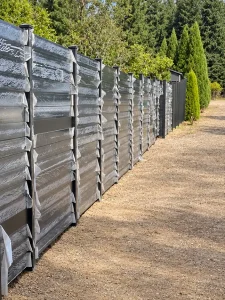
Is 2 Feet Deep Enough for Fence Posts? An Aluminum Fence Buyer’s Guide
Understand what a 24-inch depth does—and does not—tell you about an aluminum fence installation. Review post dimensions, mounting options and the information needed to order the right components.
Read the Quick AnswerIs 2 Feet Deep Enough for Fence Posts?
Two feet may be suitable for a particular fence system and site, but depth alone cannot establish whether the installation is adequate. Confirm the complete support design, including the post, foundation, connections and ground conditions, before accepting a 24-inch embedment.
2 ft = 24 in = 609.6 mm
A nominal 600 mm product detail is close to 2 ft, but it is not an exact conversion or a universal foundation specification.
For buyers ordering custom aluminum fencing, the practical question is whether the proposed post and foundation can support the selected panels and gates at the actual site. Establish that requirement before ordering post lengths or beginning excavation.
Four Dimensions to Separate on Your Drawing
| Dimension | Meaning | Why It Matters |
|---|---|---|
| Visible post height | Length above the specified finished ground level | May differ from panel height because of ground clearance and top details. |
| Post embedment | Length of the post below the drawing’s ground reference | Determines the buried portion of the ordered post. |
| Foundation depth | Depth to the bottom of the specified footing | May extend below the bottom of the post. |
| Excavation depth | Depth of the prepared hole | May include a specified base layer or other preparation beneath the footing. |
Label the ground reference clearly. Existing soil, future paving and the top of a concrete support are not necessarily at the same elevation. If landscaping changes the final level, revisit the post schedule and clearances.
A Post-Length Example
If an approved detail calls for a post to project 1,800 mm above finished ground and extend 600 mm below it, the basic length is 2,400 mm. This arithmetic does not prove that 600 mm embedment is structurally adequate. Caps, fabrication allowances and the actual connection arrangement still need to be coordinated.

Why Fence Height Alone Cannot Select a Post Foundation
A height-based rule can help explain the concept of buried support, but it leaves out important design inputs. Two panels with the same height may have different widths, infill patterns and connection arrangements. Their posts can therefore face different demands.
Likewise, a post profile that works for one layout cannot be assumed to work for a wider bay. Review the panel span, post section, wall thickness, material properties and fixing detail together. Increasing embedment does not correct an undersized post or an inadequate bracket connection.
Ask for a coordinated drawing rather than separate assumptions from different suppliers. The fence manufacturer, installer and responsible designer should be working from the same panel dimensions, finished levels and support conditions.
Site Information to Gather Before Choosing Post Depth
| Site Information | What to Provide for Review |
|---|---|
| Ground profile | Available geotechnical information, recent filling or excavation, and unusual conditions found on site. |
| Climate and frost | Project location and the applicable local frost-protection requirements where relevant. |
| Exposure | Open terrain, elevated positions, nearby buildings and the fence’s orientation. |
| Groundwater and drainage | Water encountered during excavation, ponding, irrigation and runoff paths. |
| Adjacent structures | Retaining walls, slopes, slab edges, services and nearby foundations. |
| Finished levels | Proposed paving, landscaping and level changes along each fence run. |
Do not treat a quick surface observation as a soil investigation. A firm upper layer can conceal fill or weaker material below. If excavation reveals conditions that differ from the design assumptions, resolve them before pouring or fixing posts.
Frost and Water Need a Local Detail
Where freezing ground is relevant, obtain the applicable foundation requirements for the site. A nominal 24-inch depth should not be treated as proof of frost protection. Drainage also requires a suitable detail: placing gravel in a hole does not guarantee that water has somewhere to drain.
Open Aluminum Fencing vs Privacy Fencing
Panel openness is an important input when reviewing wind effects. A closely screened boundary presents a different surface to wind than a widely spaced fence. Consider the complete layout, including corners, returns and changes in exposure.
Pour horizontal aluminum slat fences, confirm the actual slat gap and panel width. For vertical aluminum fencing, identify the profile arrangement and the intended screening level. The style name alone does not describe the loading.
Submit the chosen infill design before approving posts and foundations. If the design changes from open fencing to a privacy layout later, request a review of the support arrangement rather than reusing the original detail automatically.
Gate Posts Need Their Own Review
A gate support has responsibilities beyond holding a fixed panel. The leaf weight, hinge arrangement, operating movement and any wind acting on the gate must be considered with the post and foundation.
Include the gate width, height, infill, opening direction and hardware information in the design package. For double gates, identify both leaves, stops and any drop-bolt arrangement. Automated or sliding entrances need their own coordinated support and equipment plan.
A deeper hole is not a complete gate-post specification. Check the post section, reinforcement if required, hinge fixings and foundation connection. Explore matching aluminum gates while planning the fence so the entrance requirements are established early.
Embedded Posts and Base Plate Posts: Different Support Strategies
An embedded post extends into a below-ground foundation. A base plate post transfers loads through a plate and anchors into a supporting structure. Both require an adequate load path; the choice should follow the site and project design.
| System | Confirm Before Ordering | Avoid This Assumption |
|---|---|---|
| Embedded aluminum post | Visible height, embedment, footing dimensions and post-to-footing detail | That the listed product embedment suits every soil and exposure. |
| Base plate post | Plate and weld design, anchor arrangement, concrete condition and structural support | That any paved surface can carry the fence. |
| Reinforced post | Profile, internal reinforcement, connection details and corrosion protection | That reinforcement eliminates foundation design. |
| Wall-mounted connection | Wall structure, anchor positions and load path | That a wall cap or decorative veneer provides structural support. |

View the aluminum fence post range, including embedded square posts et base plate posts, when defining the required supply.
How to Order Aluminum Posts with the Correct Length
A purchase order should state whether the post length is total length or visible height. Do not rely on a short product title such as “1.8 m post” to settle that question. Match the order schedule to the fabrication and installation drawings.
Separate post types by location. Gate supports, corner conditions, wall connections and stepped sections may require different preparations. Assign each type a reference so the factory, packing list and installer can identify it consistently.
- Specify the finished ground reference and the required top elevation.
- State total length and embedded length separately for buried posts.
- Confirm post section, thickness, material and finish.
- Identify brackets, pre-drilled holes and hardware locations.
- List caps, anchors or site-supplied materials explicitly.
- Record approved revisions before production begins.

A Practical Workflow Before You Dig
- Select the fence and gate layout. Confirm height, bay widths, privacy requirements and entrances.
- Collect site information. Mark levels, structures, service locations and known ground conditions.
- Confirm the support design. Resolve posts, foundations, connections and any required local approvals.
- Check the order schedule. Reconcile total post lengths and component quantities with the approved drawing.
- Set out and verify. Confirm post positions, clear openings and finished levels before excavation.
- Inspect actual conditions. Resolve unexpected ground or substrate conditions before installation continues.
- Install and document. Follow the specified materials, fixing procedures and loading or curing requirements.
Arrange the appropriate utility locating process before excavation or drilling. Protect finished aluminum surfaces during handling, and keep records of foundations and concealed connections before they are covered.
What If Posts Are Already Set Only 2 Feet Deep?
First establish what was actually installed. Gather photographs, drawings and records of post length, foundation dimensions, concrete and ground conditions. A measurement of excavation depth alone may not reveal the post embedment or footing geometry.
If a post moves, a gate begins rubbing or foundations show distress, restrict use where necessary and have the support arrangement assessed. The remedy depends on the cause. Do not assume that adding a shallow concrete collar, changing a bracket or packing the surrounding soil will restore the required capacity.
For a planned upgrade to taller or more private panels, review the existing supports before fitting new infill. An installation that carried the previous fence may not be suitable for the replacement design.
Questions to Resolve Before Accepting a 24-Inch Detail
| Question | A Useful Answer Includes |
|---|---|
| What does 24 inches describe? | Clearly labeled embedment or footing depth measured from a defined level. |
| Which fence does it support? | Approved panel dimensions, infill, post profile and connections. |
| What site assumptions were used? | Ground, exposure and climate information appropriate to the project. |
| Are gates covered? | Separate gate-support details where needed. |
| What happens if conditions differ? | A review procedure before construction continues. |
| Who confirms the final installation? | Defined design, supply, installation and approval responsibilities. |
A clear specification is more valuable than a deeper number without context. Use the review to establish the full support system and to avoid ordering posts that are too short for the confirmed installation.
Fence Post Depth FAQs
Is 2 feet deep enough for a 6-foot aluminum fence?
It cannot be confirmed from height alone. Review the panel layout, posts, foundation dimensions, site conditions and local requirements for the complete system.
Is 600 mm the same as 2 feet?
No. Two feet is exactly 609.6 mm. The difference may matter on a controlled drawing, so use the approved dimensions rather than rounding during installation.
Does a lightweight aluminum fence need less support?
Material weight is only one input. Wind acting on the panels, gate operation and the capacity of the complete support system also matter.
Can a wider footing compensate for a shallow post?
Footing geometry must be evaluated as part of the design. Increasing width does not automatically satisfy embedment, frost or structural requirements.
Can I use a fence post depth calculator?
Use it only for preliminary planning unless it explicitly covers the selected system, site inputs and design requirements. A generic result is not a project approval.
Do base plate posts avoid underground foundations?
The post itself may remain above the surface, but the anchors still need an adequate supporting structure. A slab or footing may require verification or new construction.
Should every post on a project be identical?
Not necessarily. Gates, corners, level changes and special connections can require different post or support details.
Can WONDERFUL METAL supply custom post lengths?
Send the required dimensions and approved mounting detail for review. Confirm total length, profile, finish and connection preparation before production.
Discuss Your Fence and Post Requirements with WONDERFUL METAL
Plan panels, posts and gates as one supply package. Send your layout, location, panel heights, post positions, mounting method, gate details and delivery destination. Include any foundation or structural drawings already prepared for the site.
Request a Coordinated Product Quotation
We can review the requested aluminum components and supply scope against your project information. Confirm site design and installation responsibilities alongside the quotation.
Send Your Drawings & Request a QuoteE-mail : [email protected]