Privacy Fence Gate: How to Match, Specify and Install the Right System
Create a coordinated boundary with an aluminum privacy gate designed around the fence style, access requirements and site conditions.
Compare gate configurations, finish details, hardware and installation planning before you order.
Request a Matching Gate Quote
Quick Summary
A privacy fence gate should be specified as a moving part of the complete boundary system. Match the intended appearance, then coordinate the leaf size, infill, frame, posts, foundations and hardware around the actual site conditions.
Solid and closely spaced infill can create greater wind loading than an open-picket gate of the same overall size. Gate weight, width, exposure and use frequency all matter. There is no universal post burial depth, hinge count or maximum single-leaf width that suits every project.
What Makes a Privacy Fence Gate Different?
A privacy gate closes an access opening while maintaining the screening effect of the surrounding fence. Compared with an open ornamental gate, it usually presents more infill area to the wind. The design must account for the whole moving assembly, including the frame, infill connections, hinges or rollers and supporting structure.
The visual challenge is just as important. A slightly different slat width, inconsistent spacing or mismatched gloss can make the gate look like an afterthought. Establish a shared design reference for the fence and gate before fabrication.
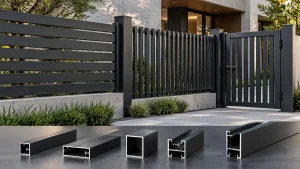
WONDERFUL METAL offers custom aluminum gate designs that can be coordinated with horizontal privacy and semi-privacy fencing ja vertical slat fence systems. Send the desired appearance and site dimensions together so the supply proposal can address both.
Match the Gate to the Fence Before Ordering
Use a dimensioned elevation rather than a color name and a rough opening alone. The gate may need a stronger frame than the adjacent fixed panel, but its visible proportions can still be coordinated deliberately.
| Match Point | What to Specify | What to Avoid |
|---|---|---|
| Privacy level | Closed, closely spaced, semi-privacy or another approved infill arrangement. | Assuming all slat designs block views equally from every angle. |
| Slat orientation | Horizontal, vertical or an intentional mixed design. | Changing direction without the client approving the elevation. |
| Slat dimensions | Face width, depth, clear spacing and alignment with adjacent panels. | Matching the general style but using a visibly different slat rhythm. |
| Height and top line | Finished gate height, ground clearance and alignment with the fence. | Confusing the gate leaf size with the overall post or panel height. |
| Finish | Color reference, gloss, texture and approved sample. | Relying on a broad description such as black or walnut. |
| Frame and posts | Visible frame width, caps, post position and connection details. | Expecting a gate frame to be structurally identical to a fixed fence panel. |
| Opening direction | Hinge side, swing direction, operating angle and full travel clearance. | Approving the appearance without checking the ground under the swing arc. |
For an existing fence, provide photographs, measured slat dimensions and the original finish reference if available. Weathering can affect the appearance of the old finish, so a new sample is useful when the match is critical.
Choose the Right Privacy Gate Configuration
| Configuration | Typical Application | Site Checks |
|---|---|---|
| Single pedestrian swing | Side yards, gardens and everyday walk-through access. | Required clear opening, hinge geometry, opening arc, ground clearance and accessibility. |
| Double swing | Wider garden, equipment or driveway access. | Each leaf size, meeting gap, leaf restraint, stops and operating sequence. |
| Tracked sliding | Entrances with lateral space but limited swing clearance. | Track support, drainage, debris, level alignment and full travel envelope. |
| Cantilever sliding | Sites where a ground track across the opening is undesirable. | Opening span plus the engineered counterbalance tail, carriage foundations and guides. |
A double swing gate commonly has two leaves that meet near the middle; it does not necessarily need a permanent center post. Confirm the drop bolt, ground receiver, stops or other restraint details for the selected manual or automated system.
Do not use a fixed five-foot rule to decide between single and double leaves. Suitability depends on the gate construction, hardware, support design and exposure. Compare aluminum swing gates ja sliding gate systems against the measured site layout.
A sliding gate does not solve every slope problem. The travel geometry, lateral storage area and drainage still need to be designed. A buried or surface track is not automatically the preferred solution for winter conditions.
Full Privacy or Semi-Privacy at the Access Opening?
Täielik privaatsus
A closed design can maintain screening at the gate. Check the frame, connections and supports for the associated wind exposure.
Osaline privaatsus
Spaced slats can allow partial visibility and airflow. Approve the view from both sides and at oblique angles.
Architectural Blade
A blade arrangement creates depth and directional screening. Review vertical blade fence options when coordinating the boundary.
Using a semi-privacy gate beside a solid fence can be a deliberate design choice. Likewise, a different slat direction may work if the overall elevation is approved. Match the finish and proportions intentionally rather than treating exact duplication as the only acceptable design.

Hardware: Specify the Actual Gate and Its Use
Select hinges, latches and closers using the actual leaf weight and dimensions, mounting arrangement, exposure and expected frequency of use. A weight rating alone does not explain every limitation of a hinge or closer.
Hinges and Connections
Follow the hardware manufacturer’s permitted leaf dimensions, hinge spacing, mounting method and number of hinges. Adding a third hinge is not a universal solution for a tall gate; incorrect alignment can create binding. Confirm reinforcement or backing where the connection requires it.
Latches and Locks
Choose the latch for the intended access function: everyday garden entry, lockable side access, managed commercial entry or a regulated barrier application. Confirm handle reach, strike clearance, adjustment range and any emergency egress requirements.
Self-Closing Devices
Where self-closing operation is required or requested, use a device suited to the gate, climate and permitted opening angle. Adjust and test closing and latching on site. Do not assume every hydraulic or spring device performs identically across the same temperature range.
Confirm the Hardware Package in Writing
List hinges, latch, lock, handles, closer, stops, drop bolts, receivers and fixings separately where relevant. Identify who supplies and installs each part so that an apparently complete gate order does not arrive without essential accessories.
Gate Posts and Foundations: Design for the Loads
The hinge-side support carries the gate’s weight and operating effects, while solid infill also contributes wind loads. A latch post or receiver has its own connection and restraint requirements. Gate supports may therefore differ from adjacent line posts.
Do not select a post simply by making it one or two nominal sizes larger. Section shape, wall thickness, reinforcement, hinge location and connection details all influence suitability. Review the aluminum post range with the gate design and confirm a project-specific schedule.
Foundation depth and dimensions depend on soil, frost conditions, wind, gate geometry and local requirements. A universal three-foot burial depth or a particular footing shape cannot be assumed suitable. For base-plated posts, verify the supporting concrete or structure, anchors, edge distances and load path.
Resolve finished ground levels and drainage before setting posts. Allow foundations to develop the required strength before hanging the gate, and check post alignment in two directions.
Commercial, Pool and Automated Gate Applications
High-traffic entrances need hardware and connections selected for the intended usage. Provide the expected daily cycles and peak use pattern instead of relying on a residential or commercial label alone.
Where access control is planned, coordinate power, communications, lock type, service access and the required egress behavior before concrete or paving work. Electronic access does not automatically require one particular latch technology; the appropriate solution depends on the application.
For pool fence and gate projects, verify the locally applicable barrier rules before fabrication. Height, openings, climbability, closing, latching and release arrangements vary by jurisdiction. A solid privacy gate should not be assumed compliant simply because it screens the pool.
For automated vehicular gates, have a qualified installer review the construction, operator, guarding and protective-device requirements for the project. Plan separate pedestrian access and test the complete system at commissioning.
If a specification requires fire, wind or coating evidence, request documentation for the actual product configuration. A fence-panel report does not automatically cover a gate, and a surface-burning classification is not a fire-resistance rating.
Installation Sequence for a Matching Privacy Gate
- Survey the opening. Record finished clear width, height, ground slope, obstacles and the access required for people or equipment.
- Approve drawings. Confirm leaf dimensions, hardware clearances, infill alignment, posts, swing direction or sliding travel.
- Coordinate support and services. Resolve foundations, post reinforcement, anchors, drainage and any wiring paths before installation.
- Set and inspect posts. Check alignment, plumb and support dimensions against the approved detail before concrete or anchors are finalized.
- Hang or guide the gate. Use the specified connections and verify free travel without scraping, binding or interference.
- Adjust latching and closing. Align the strike and set any closer according to the hardware instructions. Use product-specific tolerances.
- Test and hand over. Check operation through the required range, inspect fixings and finish, and provide operating and maintenance instructions.
Avoid solving a binding gate by forcing the latch or increasing operator force. Find the underlying alignment, foundation, clearance or hardware issue before handover.
Common Problems and What to Check
| Symptom | Possible Checks |
|---|---|
| Gate scrapes the ground | Ground profile through the travel path, hinge alignment, post movement and frame distortion. |
| Latch misses the strike | Post spacing, hardware clearances, strike adjustment and changes in alignment. |
| Closer does not latch the gate | Device suitability, setup, hinge resistance and strike engagement. |
| Gate moves in wind | Stops, restraint details, latch capacity and the design exposure. |
| Fixings loosen | Connection design, backing, selected fasteners and tightening instructions. |
| Gate looks different from the fence | Slat dimensions, alignment, frame proportions, finish sample and weathering. |
These symptoms can have more than one cause. Inspect the complete assembly before prescribing a larger hinge, deeper footing or replacement latch.
Quote the Complete Privacy Fence Gate Package
A gate leaf price is only one part of the installed cost. Compare quotations against the same drawings, finish and supply boundary. Identify local work and any automation separately.
- Gate: leaf count, dimensions, infill, frame, reinforcement and finish.
- Supports: hinge and latch posts, caps, base plates or embedded details.
- Riistvara: hinges, latch/lock, closer where specified, stops and fixings.
- Site work: foundations, anchors, grading, installation and any services.
- Kohaletoimetamine: packing, freight basis, destination, unloading and local access.
For contractor and distributor sourcing, review aluminum fence supply for contractors ja wholesale fence packages. Confirm lead time for the actual finish and quantity, including samples and drawing approval.
What to Send with Your Quote Request
| Information | Details |
|---|---|
| Project location | Country, city, exposure and application. |
| Site sketch | Finished opening, desired height, slope and adjacent fence layout. |
| Appearance | Privacy level, slat orientation, dimensions, finish and reference images. |
| Operation | Hinge side, swing direction, single/double leaf or sliding arrangement. |
| Usage | Expected traffic, lock/closer needs and any automation plan. |
| Documentation | Applicable project specifications and required design or test evidence. |
| Supply scope | Posts, caps, hardware, spares, matching panels, quantity and delivery basis. |
Korduma kippuvad küsimused
How wide should a privacy fence gate be?
Base the clear opening on the people, equipment or vehicles that need access and any applicable accessibility rules. Confirm the leaf dimensions after allowing for hinges, posts, latching and the selected operating system.
When should I use a double gate?
A double gate can suit a wider opening or reduce individual leaf width, but the choice depends on the frame, hardware, supports and available space. There is no universal width at which every single gate must become a double.
How many hinges does a privacy gate need?
Use the number and spacing specified for the selected hardware and gate design. Height alone does not determine the answer; width, weight, mounting and alignment also matter.
How deep should privacy gate posts be installed?
Follow the approved foundation design and local requirements. Soil, frost, wind and gate loads determine the depth and dimensions; a single standard burial depth does not suit all sites.
Can the gate use different slats from the fence?
Yes, if the visual transition is intentional and approved. Coordinate finish, proportions and privacy expectations in an elevation before production.
Are privacy fence gates automatically pool compliant?
No. The complete barrier and gate arrangement must meet the applicable local requirements. Confirm the necessary design, hardware and operation before ordering.
Can an existing fence panel be converted into a gate?
Do not assume a fixed panel is suitable as a moving leaf. A gate needs an appropriate frame, connections, hardware and supports. Have the proposed conversion reviewed before modifying the panel.
Are matching posts and hardware included?
Inclusions depend on the confirmed quotation. Ask for a bill of materials identifying the gate, supports, caps, hardware and any excluded local or automation components.
How do I maintain an aluminum privacy gate?
Follow the supplied care instructions, clean with suitable non-abrasive methods and inspect hinges, latches, stops and fixings. Investigate changes in alignment or closing performance promptly.
Specify the Gate with the Rest of Your Fence
Request a Matching Privacy Fence Gate
Send WONDERFUL METAL your opening dimensions, fence style, finish reference, site sketch and destination. Include the required operating method and hardware scope so the gate and supporting components can be discussed together.
Send Your Drawing & Request a QuoteTutvuge alumiiniumväravatega