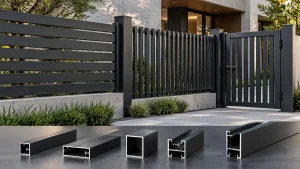
Driveway Gates: Styles, Materials and Automation Options
Specify an entrance that suits the driveway, coordinates with the fence and is ready for the intended access system.
A practical guide to aluminum swing and sliding gates, hardware, site planning and installation.
Discuss Your Gate ProjectBrowse Gate Designs
Quick Summary
Choose a driveway gate around the site first: the finished opening, driveway slope, available swing or sliding space, wind exposure and daily traffic. Then define the frame, posts, foundations, hardware and access system as a coordinated package.
WONDERFUL METAL supplies custom aluminum gate designs for residential and commercial entrances. Discuss manual or automation-ready configurations, matching fence profiles, finish samples and export packing at quotation stage. Motors, controls, safety devices and installation services must be confirmed in the order scope.
Why the Driveway Gate Should Be Specified First
The driveway gate is a moving structure at the most visible point of the boundary. Its frame must remain aligned, its foundations must resist the relevant loads, and its hardware must work through repeated opening cycles. A good-looking fence cannot compensate for a gate that drags, binds or stops halfway through its travel.
Start the perimeter design with the gate opening and operating method. Hinge geometry affects swing clearance, cantilever hardware affects the support layout, and access control affects power and communications planning. Approve these details before ordering adjacent fence panels.
Browse the WONDERFUL METAL aluminum gate range to compare entrance styles, then send a measured site sketch so the proposed design can be reviewed against the actual opening.
Swing vs Sliding Driveway Gates: Choose by Site Conditions
Neither opening system is best for every driveway. A wide opening can use an engineered double swing, while a narrow entrance may still need a sliding gate because the swing arc is obstructed. Avoid using a single width threshold as the deciding rule.
| Gate System | Space and Ground Conditions | Items to Resolve |
|---|---|---|
| Single or double swing | Needs a clear opening arc and sufficient clearance above the entire swept ground area. | Leaf width, opening angle, hinge position, stops, wind exposure and operator mounting. |
| Tracked sliding | Needs lateral storage space and a correctly supported, aligned track route. | Drainage, debris, snow and ice, wheel loads, track level and the full travel path. |
| Cantilever sliding | Runs clear of the driveway surface but requires room for the opening span plus the engineered counterbalance tail. | Gate overall length, carriage spacing, support foundations, guides and receiver details. |
| Folding | May suit constrained sites where ordinary swing or slide layouts do not fit. | Panel articulation, pinch points, clearances and specialist hardware or automation compatibility. |
When a Swing Gate Fits
A single or double aluminum swing gate can suit entrances with an unobstructed swing path. Measure the grade under both leaves throughout the intended opening angle. An uphill driveway may require a different opening position or another system; raising the gate alone can leave an unacceptable bottom gap.
When a Sliding Gate Fits
A sliding aluminum driveway gate can be useful where the swing arc is unavailable. Check the complete lateral travel envelope, including guides, catches and service access. A cantilever gate needs a counterbalance section whose length is determined by the selected system, not a universal allowance of one or two feet.
Sliding gates also need an engineered travel geometry. Do not assume a gate can follow any driveway slope or that a cantilever system always reduces site preparation. Survey crossfall, drainage, retaining walls and the receiving area before selecting hardware.
Aluminum, Steel and Wrought Iron: Compare the Complete Gate
Material affects handling, frame design, corrosion care and appearance. Operator selection still depends on the actual gate dimensions, weight, wind area and duty cycle. A lighter gate does not automatically justify a smaller foundation or motor.
| Material | Practical Advantages | Specification Considerations |
|---|---|---|
| آلومینیوم | Generally lighter than a comparable steel layout; no red rust from the aluminum body; works with slat, blade and decorative designs. | Confirm frame stiffness, connections, finish, mixed-metal detailing and wind loads. |
| Steel | Can suit demanding structural designs and fabricated decorative patterns. | Protect against corrosion and specify the actual gate weight, coating system and maintenance plan. |
| Genuine wrought iron / decorative ironwork | May suit restoration work or a particular traditional appearance. | Verify the actual material supplied; many products described as wrought iron are fabricated steel. |
For residential and light commercial entrances, aluminum can offer a useful combination of manageable handling and coordinated appearance. Compare vertical slat fencing و حصارکشی با تیغههای عمودی when selecting an entrance pattern.
Material alone does not establish security performance. A steel gate is not automatically vehicle-impact rated, and an ordinary aluminum driveway gate should not be represented as a crash barrier. Projects requiring impact resistance need a specifically rated system and matching installation conditions.
Select the Infill, Privacy Level and Finish
Open Picket or Blade
An open pattern supports sightlines and can complement ornamental fencing. Review openings, projecting details and automated-gate guarding requirements separately.
Semi-Privacy Slat
Adjust the visual rhythm with slat width and clear spacing. Check both straight-on and angled views before approving the pattern.
Privacy Infill
A closed appearance can screen the driveway, but larger solid areas increase wind effects. Confirm the entire structural and operator design.
Define the color reference, gloss and texture on an approved sample. If a woodgrain appearance is required, confirm availability, the finish method and sample approval rather than assuming every product uses the same coating process. Order matching gate and fence finishes together where possible.

Driveway Gate Automation: Define the Access Experience
Choose the access method around the people who use the entrance, then confirm compatibility with the operator and safety system. An automation-ready gate is not a complete commissioned automatic gate package.
| Access Level | Possible Features | Questions Before Ordering |
|---|---|---|
| Manual gate | Latch, lock, handles and mechanical stops. | Who opens it, how often, and how is it secured in the open position? |
| Powered residential | Compatible operator, remotes and optional keypad or intercom. | What are the power source, climate rating, release procedure and protective-device requirements? |
| Multi-user access | Credentials, keypad codes, access schedules or managed entry. | How are users added, removed and recorded? Who administers the system? |
| Connected entry | App access, video intercom or integration with a property system. | Is network coverage reliable? Are subscriptions, data handling and outage behavior acceptable? |
A qualified installer should select the operator for gate length and weight, wind exposure, hinge or carriage geometry, traffic peaks, operating temperature and the manufacturer’s permitted duty cycle. A heavier-duty motor does not correct a binding gate or remove the need for safety assessment.
Plan Power and Communications Early
Identify the power source and cable route before paving or landscaping. Have the electrical designer determine conductor sizes, voltage drop, conduit capacity, separation of power and communications, grounding and local protection requirements. Consider spare conduit for future upgrades rather than prescribing one conduit size for every site.
Hardware and Foundations: Specify a Coordinated System
Hinges, Carriages and Stops
Use hardware approved for the gate dimensions, weight and operating geometry. Hinge loading depends on leaf width and hinge spacing as well as mass. Cantilever carriages, guides and supporting structures must be selected as a compatible system. Confirm stops, anti-lift or retention details and service access in the drawings.
Posts and Footings
Gate posts may require heavier sections or reinforcement compared with line posts. Review aluminum post options with the gate proposal, but base the final post and footing schedule on the actual loads, soil and local conditions.
There is no universal three-foot footing depth or standard footing diameter for all driveway gates. Frost depth, wind, ground conditions, leaf size, post leverage and the support arrangement determine the required foundation. Base plates also require a verified supporting structure and an appropriate anchor design.
Finish and Connections
State the coating requirements, hardware materials and any isolating details. Aluminum does not develop steel-like red rust, but it can still corrode under unsuitable exposure or joint conditions. Keep drainage paths clear and follow the approved methods for cutting, drilling and repairing finish damage.
Automatic Gate Safety: Treat the Entrance as a Complete System
For North American projects, review ANSI/CAN/UL 325 for operators and systems and ASTM F2200 for automated vehicular gate construction, together with the requirements adopted locally. These references address different parts of the installation; specifying a motor alone does not establish compliance for the finished entrance.
The installer must identify entrapment and pinch zones throughout the travel path, including the opening side, closing edge, posts and adjacent fence. Select compatible protective devices and test them according to the operator instructions and applicable requirements. A fixed prescription such as “two photo-eyes and a reversing motor” may not address every installation.
Provide separate pedestrian access and keep it clear of vehicular gate movement. Position controls and guarding according to the approved layout. Show the owner how to use the gate, follow the emergency release procedure and arrange periodic safety checks.
For additional guidance, see the DASMA gate operator safety resources. Electrical work, emergency access and local approvals should be coordinated by the responsible qualified professionals.
Do not transfer a wind-speed claim, fire report or certification from a fence panel to a driveway gate. Where documentation is required, confirm that it applies to the specified assembly and installation.
Installation Planning: From Survey to Handover
- Survey the finished entrance. Record opening width, height restrictions, grade in both directions, boundaries, utility locations and vehicle turning needs.
- Approve the gate layout. Confirm clear opening, leaf dimensions, frame sections, support positions, hardware, travel envelope and fence interfaces.
- Coordinate civil and electrical work. Resolve footings, drainage, track bases where relevant, conduit routes, power and communications before construction.
- Install supports to the approved details. Check alignment and levels, and allow foundations to reach the required strength before applying loads.
- Fit and check the gate mechanically. Verify free travel, stable guides or hinges, designed clearances and stops before connecting automation.
- Install and commission the operator. Follow the manufacturer’s instructions, assess all hazard zones and test the installed protective devices.
- Document the handover. Supply the approved drawings, operating instructions, release procedure, service schedule and component references.
Schedule time for fabrication, transport, foundations, curing, electrical work and commissioning. A quoted installation duration should reflect the site conditions instead of assuming every driveway can be completed in one or two days.
Common Problems That Cause Gate Callbacks
| Problem | What to Check Before Handover |
|---|---|
| Gate drags or alignment changes | Foundation design, post movement, hinge adjustment, frame geometry and full-travel ground clearance. |
| Operator stalls or cycles inconsistently | Mechanical resistance, power quality, sizing, limit setup and protective-device status. |
| Snow or debris blocks travel | Track maintenance, driveway drainage and the planned snow-storage area. |
| Users cannot enter during an outage | Documented release procedure, authorized access and any specified battery backup. |
| Gate finish looks different from adjacent fencing | Approved sample, gloss, texture and batch identification. |
| Automation scope is incomplete | A signed inclusions list covering motor, supports, controls, protective devices, wiring and commissioning. |
The operator should move a correctly installed gate. Do not compensate for mechanical defects by increasing force settings or bypassing protective devices.
How to Compare Driveway Gate Prices
Separate the gate supply price from the installed project total. Site excavation, foundations, electrical work, automation and commissioning can change the budget substantially. Compare offers on the same dimensions, finish, hardware and delivery terms.
- Gate fabrication: leaf count, opening size, frame, infill, reinforcement and finish.
- Supports and hardware: posts, base plates, hinges, rollers, guides, stops and fasteners.
- Automation: operator, mounting kit, compatible controls, protective devices and backup options.
- Local works: excavation, concrete, electrical supply, communications and installation.
- Logistics: export packing, freight, import costs, unloading and delivery access.
Confirm whether supply is factory-only, delivered to a named port, or supplied under another agreed delivery basis. Contractors and dealers can also review contractor fence supply و wholesale fence packages for coordinated perimeter orders.
Specification Checklist Before You Request a Quote
| Send This Information | Include These Details |
|---|---|
| Location and application | Destination country/city; residential, shared access or commercial use. |
| Opening and layout | Finished clear width, desired height, post locations and measured sketch/CAD. |
| Site geometry | Slope, swing arc or lateral travel space, walls, drainage and snow conditions. |
| Design and finish | Slat, blade, picket or privacy infill; spacing; color, gloss and reference images. |
| Operating method | Manual, single/double swing, tracked slide, cantilever or a folding concept. |
| Automation requirements | Preferred operator if known, usage pattern, power source and access devices. |
| Documentation | Local performance requirements, engineering inputs and any required reports. |
| Order and delivery | Quantity, matching fence lengths, requested schedule and delivery destination. |
State whether the operator and safety installation will be supplied locally. This lets the gate fabricator coordinate mounting provisions without assuming responsibility for components outside the agreed supply scope.
Frequently Asked Questions
Is aluminum a good material for a driveway gate?
Aluminum can be a useful choice where manageable handling, corrosion care and a coordinated finish matter. The frame, supports and connections still need to be suitable for the gate dimensions and site loads.
Should I choose a swing gate or a sliding gate?
Choose from the measured site conditions. Swing gates require a clear arc; sliding gates require lateral travel space. A cantilever design additionally needs its engineered counterbalance tail and support layout.
Can the driveway gate match my aluminum fence?
Coordinate the infill profile, spacing, color, gloss and cap details at quotation stage. Approve finish samples and drawings for both the gate and fence package.
Are automatic gate motors included?
Inclusions depend on the confirmed quotation. Identify the operator, mounting kit, controls, safety devices, electrical works and commissioning separately. Automation-ready fabrication does not mean those items are all included.
How deep should gate posts be set?
Use a project-specific footing design based on loads, soil, frost conditions and local requirements. There is no single burial depth that suits every driveway gate.
Can I install a driveway gate on a slope?
Often a suitable layout can be developed, but the whole travel path must be measured. An uphill swing arc or a sloping sliding route requires careful geometry and hardware review.
What happens when the power fails?
Follow the release and access procedure specified for the selected operator. Confirm how authorized users reach and operate the release. Battery backup is an option only where included and compatible.
How should an automated gate be maintained?
Follow the gate and operator manuals. Check the mechanical parts, drainage and protective devices at the required intervals, and have faults assessed by a qualified technician. Do not bypass safety devices to keep a faulty gate operating.
Plan a Complete Aluminum Driveway Gate Package
Send Your Opening Dimensions and Site Sketch
WONDERFUL METAL can review custom aluminum gate styles, frame and infill requirements, matching fence profiles, finish options and export packing for contractor and wholesale orders.
Start with the opening width and height, a site sketch, the preferred movement type and the delivery location. Include your automation plan so mounting provisions and supply boundaries can be discussed before fabrication.
Request a Driveway Gate Quoteکاوش دروازههای آلومینیومی