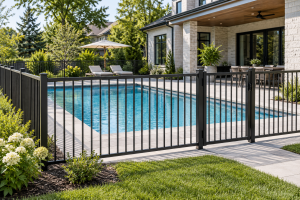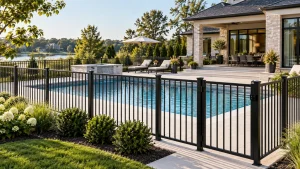
Residential & Commercial Aluminum Pool Fencing for Global Projects
Combine architectural appearance with a carefully specified barrier. Explore panel construction, finish options, matching gates and the regional safety requirements that shape a complete pool enclosure.
Explore Pool Fence SystemsSend Your Project BriefA pool fence is part of the landscape and part of an access-control system. Its appearance should suit the property, while the installed height, openings, supporting posts and gate operation must address the requirements of the project location.
Wonderful Metal manufactures aluminum fence and gate systems for international buyers. Established in 2021, we combine a Qingdao office with a Linqu, Shandong factory and 5+ years of manufacturing experience. Our work covers custom products and coordinated project supply. Meet Wonderful Metal.
Residential and Commercial Pool Fencing: Different Projects, Different Briefs
Ornamental aluminum fencing can create a consistent architectural boundary around both homes and larger developments. Custom dimensions help address different layouts. However, a product described as “commercial grade” still needs a defined structural specification and a separate assessment of pool barrier suitability.
Residential Pools
For homes and villas, start with views from the house, child access routes, garden levels and the gate location. A simple open fence can preserve visual connection between the pool and surrounding outdoor space.
Confirm how doors, walls and property boundaries interact with the enclosure. Do not assume the outer garden fence alone provides the required isolation.
Commercial & Shared Pools
For hotels, apartments and community facilities, define expected use, operating arrangements and the responsible approval authority. Coordinate the pool enclosure with accessible routes and emergency egress requirements.
Specify structural performance, hardware duty and inspection expectations. Public-use requirements may extend beyond those for a private residential pool.
Wonderful Metal’s pool fencing range supports homes, villas, hospitality and development enquiries. Panel dimensions, spacing, post design, gates and colors can be adapted to the agreed specification. Explore our pool fence range.
Panel Construction: Look Beyond the Grade Name
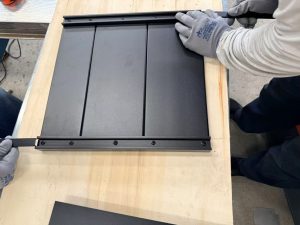
Factory-assembled sections can simplify site work, while custom sections can resolve particular widths and heights. Before choosing an assembly format, check handling, fixing methods and the installation sequence with the contractor.
Profiles, Rails and Connections Work Together
Section size, wall thickness, alloy, temper, rail span, joints and post restraint all influence performance. Adding material to one rail does not establish the strength of an entire enclosure. Request a specification for the complete system rather than comparing products using a single thickness figure.
For a project enquiry, identify the loads and performance evidence required by the engineer or approving authority. Where testing is required, confirm that it covers the proposed configuration, including its supports and connections.
Assembled Panels or Component Supply?
Record whether the order includes completed panels, separate components or a combination. Check that the assembly method is consistent with the agreed design and that installation instructions cover the actual supplied parts. Site assembly changes should be reviewed before use.
Slopes Need a Planned Solution
Some panel systems are designed to rack within a stated range; others need stepped sections or purpose-made panels. Never assume a fixed panel follows a slope. Mark levels on the layout and check the resulting height and bottom gap at every transition.
At a wall, corner or retaining structure, assess the whole opening rather than just the space beneath the center of a panel. These junctions should appear on the approval drawings.
Architectural Styles, Powder Coating and Matching Gates


Open Pickets and Flat Tops
Vertical pickets and restrained top lines suit many outdoor settings. Assess rail placement, clear openings and the top treatment together. Decorative rings, projecting finials and shaped profiles require additional attention to climbing opportunities and injury risks.
Privacy and Louvre Layouts
Screening can help separate a pool environment from neighboring properties, but a privacy or louvre fence is not automatically a suitable pool barrier. Consider visibility, footholds, openings and wind loading. In some layouts, separate privacy screening outside the pool enclosure may be a more practical design choice, subject to local review.
Powder-Coated Aluminum
Wonderful Metal offers powder-coated finishes, including matte black and custom RAL colors, with matching gate options. Material selection commonly includes 6063-T5/T6 aluminum according to the design. Review available customization.
Specify coating requirements for the actual exposure, including coastal salt and pool chemicals. Agree samples and care instructions. Aluminum avoids the red rust associated with steel, but it still needs compatible fixings, sound coatings and routine inspection.
Global Pool Fence Policies: A Guide to Selected Markets
Use the following comparison to prepare questions for your local reviewer. It separates guidance, regional regulations and recognised compliance routes; it is not a complete legal specification for any installation.
| Jurisdiction | Key published provisions | Project action |
|---|---|---|
| United States CPSC residential guidance | CPSC recommends a barrier at least 48 in high, openings excluding a 4 in sphere, and pedestrian gates opening away from the pool with automatic closing and latching. This is guidance rather than a mandatory federal pool fence code. [1] | Check the adopted state/local code, measuring method, ground clearances, rail layout and latch protection. |
| Australia — NSW | Published NSW requirements include at least 1.2 m height, maximum 100 mm gaps beneath the fence and between vertical bars, and 1.8 m for a boundary fence used as the barrier. Climbable horizontal bars require at least 900 mm separation. [2] | Confirm the applicable rules for the pool’s age, boundary arrangement, gate and non-climbable zones. Review other states separately. |
| New Zealand | Residential barriers restrict access by unsupervised children under five. F9/AS1 includes 1200 mm barrier/gate provisions and outward-opening gates with automatic closing and latching. [3] | Confirm the applicable compliance route, full geometry, consent and existing-pool provisions. [9] |
| Canada — Québec | Where an enclosure is required, the regulation specifies at least 1.2 m height, exclusion of a 10 cm sphere and features that do not facilitate climbing. Gates must close and latch automatically. [4] | Check municipal permits, exceptions and latch position. These provisions do not represent a Canada-wide specification. |
| France | For private uncovered in-ground pools within the government guidance’s scope, a barrier, alarm, safety cover or shelter is required. NF P90-306 is the identified recognised barrier standard. [5] | Confirm pool classification and the selected safety device route. If a barrier is chosen, assess the complete system. |
| United Kingdom | HSE pool operator guidance describes general health and safety duties and suitable risk assessment, particularly for pools used by the public. [6] | Determine the facility’s access-control requirements. Do not interpret this as one universal domestic fence-height rule. |
| UAE — Dubai villas | Building Code Part K lists at least 1200 mm fence height, maximum 50 mm bottom clearance and openings excluding a 100 mm sphere. Gate provisions include outward opening, self-closing, self-latching and locking, with defined exceptions. [7] | Check the current authority requirements. Dubai’s 2026 public safety law also requires approval of pool plans/design, including private villas. [8] |
Three Details That Can Change Your Specification
- Rail geometry: CPSC guidance treats horizontal members less than 45 in apart differently, recommending pool-side rails and vertical openings no wider than 1¾ in. Do not reduce the entire design to a height and picket gap. [1]
- Measurement units: 48 in equals 1219.2 mm, not 1200 mm. A 4 in opening equals 101.6 mm, not 100 mm. Use the required units and leave appropriate tolerance margins.
- Surrounding objects: NSW’s non-climbable zone guidance includes nearby objects and space within the enclosure. Keep furniture and landscaping from creating access aids. [2]
For countries not listed here, obtain the current official requirements locally. For public pools, also identify the applicable operating, accessibility and emergency escape requirements before finalizing a barrier layout.
Custom Manufacturing Around Different Buyer Needs
Wonderful Metal supports OEM/ODM and wholesale enquiries, with coordinated panels, posts, gates and specified accessories. Customization should begin with the destination requirements and a clear drawing set rather than an assumed “global standard” size.
| Buyer need | What to specify | What to agree before production |
|---|---|---|
| Residential installers | Site plan, levels, gate opening and boundary connections. | Panel lengths, post positions, mounting and all transition details. |
| Hotels and developers | Facility use, engineering brief, access requirements and finish schedule. | Approval responsibilities, evidence requirements and the exact gate assembly. |
| Distributors and brands | Target market, product range, packaging and repeat-order needs. | Controlled profile and hardware specifications, sample approval and change management. |
| Coastal projects | Salt exposure, chemical contact and maintenance conditions. | Material, coating and fixing compatibility, plus maintenance instructions. |
From the Enquiry to a Reviewable Order
- Share the brief. Provide project location, required rules, drawings, quantities and delivery destination.
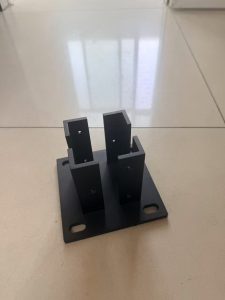
- Resolve the details. Identify panel dimensions, profile sections, gate hardware, post supports and the required evidence.
- Approve the specification. Confirm drawing revisions, color samples, bill of materials and inspection requirements.
- Check and pack. Review dimensions, fabrication, finish and component counts against the agreed order, then confirm protective packing and dispatch documents.
Our Linqu production operations cover profile processing, fabrication, finishing, inspection and packaging, while the Qingdao office supports customer communication and export coordination. Read about our factory and team.
Installation and Long-Term Care
Confirm the substrate, foundations and anchors with the responsible installer or engineer. After installation, assess the entire perimeter, test gate closing and latching, verify installed clearances and check nearby climbing aids.
Keep records of hardware instructions and maintenance. Inspect loose fixings, coating damage, distorted members and ground movement. Recheck after landscaping or gate adjustments, and repair faults promptly. Pool barriers support layers of protection and never replace adult supervision.
Aluminum Pool Fence Questions
Does commercial grade automatically mean pool compliant?
No. The grade name does not define all structural or barrier requirements. Confirm the exact sections, connections, gate assembly and applicable local rules.
Can you supply pre-assembled panels?
Discuss the preferred supply format with the quotation. Confirm panel construction, assembly responsibilities and packing dimensions for the selected design.
Can I use a louvre or privacy fence around a pool?
Only after reviewing the specific layout against local requirements, including climbing geometry, visibility where relevant, wind loading, gates and openings.
Can a pool fence follow a sloping garden?
A slope needs a designed solution. Confirm whether the system permits racking, requires stepped sections or needs custom panels, and verify the resulting installed gaps and heights.
Are the same dimensions suitable worldwide?
No. Requirements vary between countries and within them. Even nominally similar inch and metric dimensions can differ enough to affect suitability.
What should I send Wonderful Metal for a quote?
Send the destination, applicable requirements, site layout, dimensions, quantities, gates, preferred color, required documents and delivery terms.
Define Your Pool Fence System with Wonderful Metal
Share your site plan and market requirements to discuss panels, posts, matching gates and the proposed manufacturing scope.
Request a Custom QuotationView Pool FencingEmail: [email protected]
Official References & Further Reading
Policy references reviewed for this article on November 8, 2026. Consult the current official text and local authority for the complete requirements, exceptions and approval process.
- U.S. CPSC — Safety Barrier Guidelines for Residential Pools (guidance, not a mandatory federal fence code).
- NSW Government — Pool owner obligations and fence measurements.
- New Zealand MBIE — F9 Acceptable Solutions, residential pool barriers.
- LégisQuébec — Residential Swimming Pool Safety Regulation.
- French government — Safety devices for private pools.
- UK HSE — Swimming pool safety management.
- Dubai Building Code, 2021 edition — Part K, section K.5.8.2.3.
- Dubai Law No. 2 of 2026 — Public Safety, Article 11.
- New Zealand MBIE — Requirements for residential pool barriers.